The Legacy of the Italian Whisky Maestro: Silvano Samaroli
Mar 7, 2026
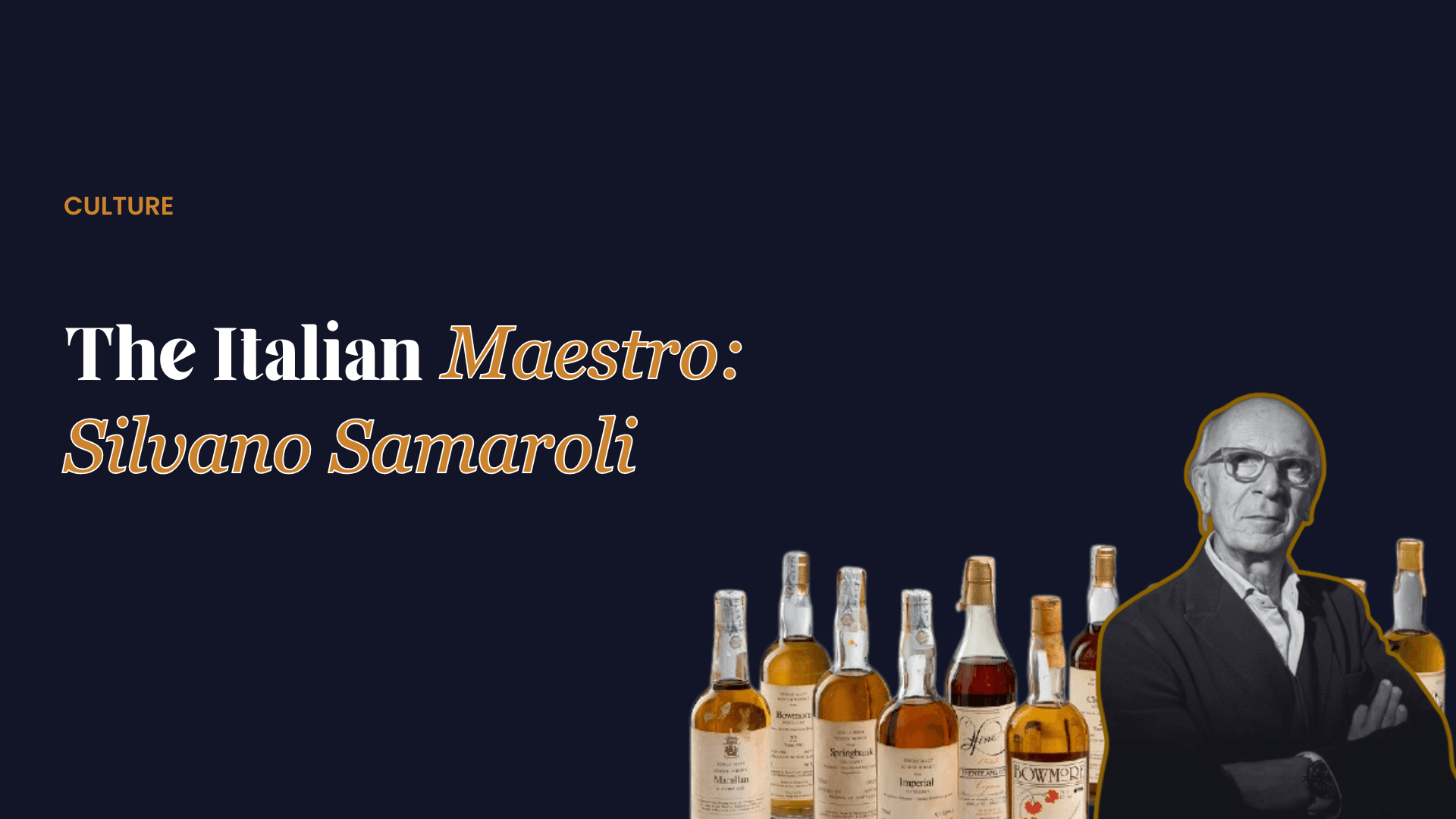
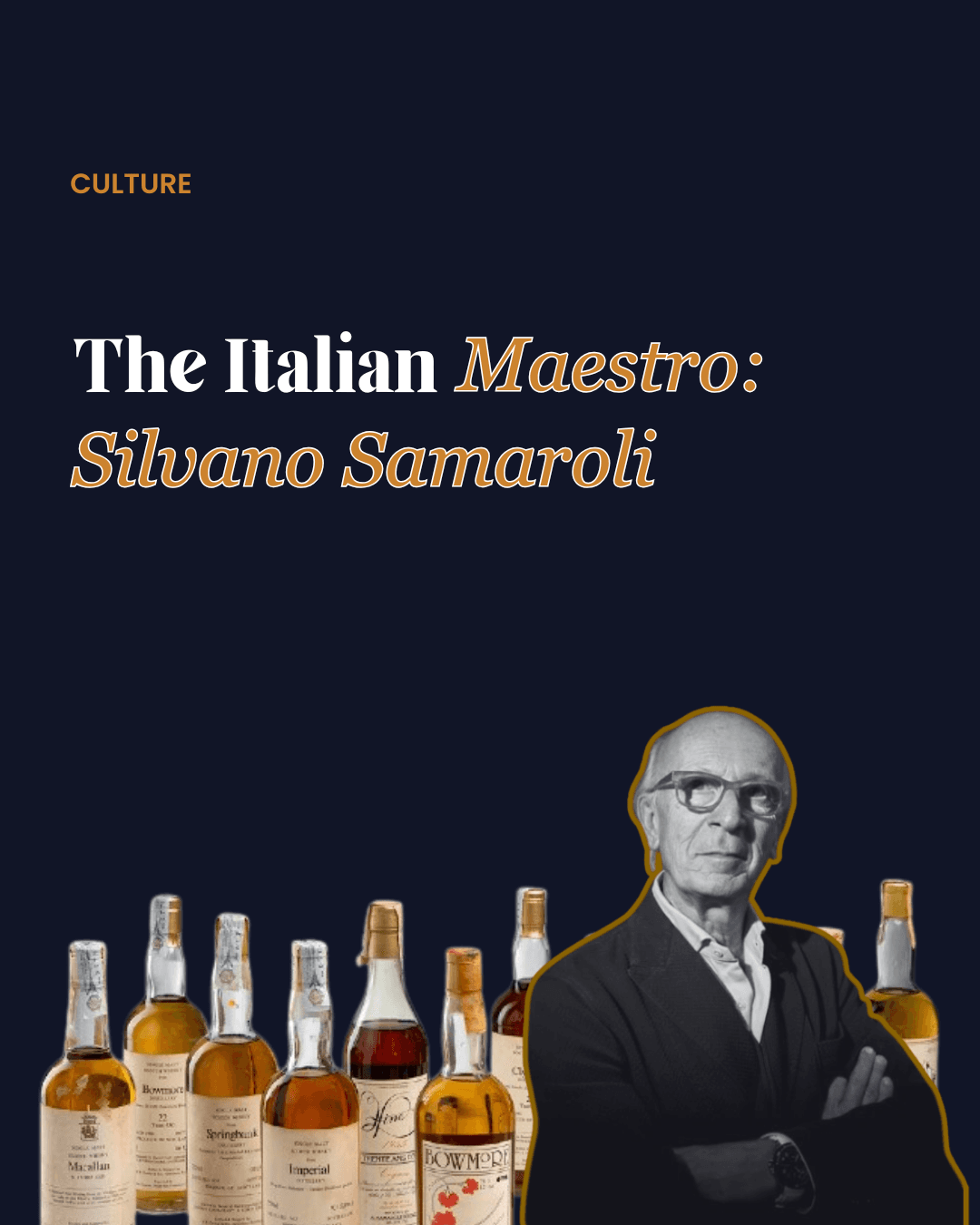
In August 2018, a single bottle of Laphroaig 1967 15 Year Old sold for £61,000 at Whisky Auctioneer. The whisky wasn't from Laphroaig itself. It was selected, bottled, and labeled by an Italian gentleman named Silvano Samaroli, who signed this particular bottle before his death in 2017. That signature alone transformed an already legendary bottle into something even more extraordinary.
One month earlier, a Bowmore 1966 Bouquet - another Samaroli bottling - sold for £51,611. In 2019, Sotheby's auctioned another Bowmore Bouquet for £72,600. These aren't distillery bottlings. They're independent selections from a man who never owned a distillery, never operated a still, and worked from Rome - over 1,000 miles from Scotland.
This is Silvano Samaroli's legacy. While distilleries built their reputations over centuries, this Italian independent bottler created a body of work so exceptional that his name became more valuable than many of the distilleries he bottled. Four of the top five highest-rated whiskies on WhiskyBase's Top 1000 list were bottled by Samaroli. Serge Valentin awarded two of his bottles - the Bowmore Bouquet and Laphroaig 1967 - a perfect 98 points, calling them among the best whiskies ever made.
Samaroli pioneered the entire approach to independent bottling that defines the category today - cask strength releases, detailed provenance documentation, artistic label design, and small-batch limited editions. Emmanuel Dron, owner of Singapore's Auld Alliance bar and Samaroli's close friend, said simply: "Some of his bottlings are just the best whisky I ever tried in my life."
Understanding Independent Bottlers
To appreciate Samaroli's legacy, you first need to understand what independent bottlers do and why they exist. Most whisky comes directly from distilleries - Glenfiddich bottles Glenfiddich, Laphroaig bottles Laphroaig, Maker's Mark bottles Maker's Mark. But Scotland's whisky industry has always had another category: independent bottlers who purchase casks from distilleries, age them, and release them under their own labels.
Independent bottlers emerged in the 19th century when many distilleries lacked bottling facilities or national distribution networks. Companies like Gordon & MacPhail (founded 1895) and William Cadenhead (founded 1842) bought casks wholesale, matured them in their own warehouses, and sold them to retailers across Britain and beyond. This system benefited everyone - distilleries got immediate cash flow, bottlers built their businesses, and consumers accessed whiskies that might never have reached their local markets.
But independent bottling evolved beyond mere distribution. By the mid-20th century, skilled bottlers began hand-selecting exceptional casks that distilleries might overlook or blend away. A distillery producing 5 million liters annually can't give individual attention to every cask. An independent bottler purchasing 50 casks can taste each one, identify the absolute best, and release them as single-cask bottlings at optimal maturity.
This is where artistry enters. Distilleries aim for consistency - every bottle of Laphroaig 10 Year should taste like Laphroaig 10 Year. Independent bottlers pursue uniqueness - finding that one Laphroaig cask from 1967 that transcends everything else the distillery ever produced. They're curators rather than producers, selecting whisky the way a museum curator selects art.
The best independent bottlers - Samaroli, Cadenhead, Signatory, Gordon & MacPhail - developed reputations where their selections became more valuable than standard distillery releases. A Cadenhead-selected Springbank might command double the price of a distillery bottling from the same vintage. Why? Because collectors trust that Cadenhead's cask selection identified something extraordinary.
Silvano Samaroli took this concept further than anyone. He wasn't just selecting good casks - he was creating a complete aesthetic vision. Every element mattered: the whisky's quality, the bottling strength (he pioneered cask strength when most bottled at 40% ABV), the detailed tasting notes and provenance information, and above all, the artistic label designs that made each bottle a collectible object independent of the liquid inside.
Where other independent bottlers operated as businesses, Samaroli operated as an artist. Francesco Saverio Binetti, Samaroli's former sales manager, captured this perfectly: "Samaroli had more the soul of an artist than of an entrepreneur, and probably, we too today should start considering his work in this way, and as an artist is remembered for his work, the same should be for Samaroli's work."
Why Samaroli Stands Apart
Samaroli's legacy rests on three pillars that separated him from every other independent bottler of his era.
First, visionary cask selection during whisky's golden age. Throughout the 1960s and 1970s, single malt Scotch was deeply unfashionable. Blended whisky dominated global markets, and distilleries sold single malt casks for relative pennies. Samaroli traveled to Scotland when few Italians cared about whisky, visiting distilleries like Bowmore, Laphroaig, and Bruichladdich to taste through their warehouses. He had an extraordinary palate - what the industry calls "an incredible nose" - that identified casks with aging potential others missed.
The 1966 Bowmore he selected represents this perfectly. Bowmore produced thousands of casks in 1966. Samaroli tasted through them and identified the one that would become the Bouquet - a cask so exceptional that 18 years later, when bottled, it would score 98 points from Serge Valentin and be called "utterly spellbinding." That's not luck. That's genius-level cask selection.
Second, pioneering the independent bottling standards now considered essential. When Samaroli started bottling in the late 1970s, most independent bottlers provided minimal information - distillery name, age, and proof. Samaroli included cask numbers, wood types, distillation dates, bottling dates, and poetic tasting notes that helped drinkers understand what they were experiencing. He championed cask strength when the industry preferred watered-down 40% ABV. He bottled from single casks when blending multiple casks was standard.
By the late 1980s, nearly all Samaroli releases were cask strength with comprehensive documentation - setting a precedent that modern independent bottlers like Signatory Vintage and The Scotch Malt Whisky Society still follow. Emmanuel Dron notes that Samaroli was also "a pioneer of no-age-statement whiskies," creating his "No Age" series from 1992-2016 with full transparency about what he was doing, decades before the practice became common.
Third, treating each bottle as art rather than product. Samaroli designed his own labels - the elegant floral illustrations of the Flowers series, the personal calligraphy of the Handwritten Labels, the distinctive typography of his early releases. These weren't marketing gimmicks. They were artistic expressions that made each bottle beautiful whether you ever opened it or not. The label aesthetic mattered as much as the liquid, creating collectible objects that transcended mere alcohol.
When you combine exceptional palate, pioneering practices, and artistic vision, you get bottles that command prices far exceeding standard distillery releases. A Samaroli-selected Bowmore 1966 sells for £72,600 when comparable distillery Bowmore from 1966 brings £5,000-8,000. The premium isn't hype. It's recognition that Samaroli's cask selection represented the absolute pinnacle of what that distillery could produce.
The Man Behind the Legend
Julian "Pappy" Van Winkle started as a traveling bourbon salesman. Silvano Samaroli started with dreams of becoming a pilot like his father, an Italian Air Force officer stationed in Libya where Silvano was born on October 15, 1939. Those dreams evaporated after finishing school, and Samaroli took his first job as a sales manager for a liquor store in Italy.
That retail experience developed his palate and business acumen. In 1968, at age 29, Samaroli founded Samaroli Srl Wine and Spirits Merchants in Rome. For the first decade, the company operated as an importer - the official Italian distributor for John McEwen & Co brands including Chequers and Abbot's Choice blends, plus Linkwood and Glen Garioch single malts.
The transition from importer to bottler began in 1969 when Samaroli imported a special cask strength Linkwood for restaurateur Edoardo Giaccone. That introduction to cask strength whisky - rare in an era of 40% ABV dominance - inspired Samaroli to seek his own exclusive releases. In 1975, he visited Bruichladdich distillery and selected two 10-year casks distilled in 1965, bottling both at cask strength.
His first major series came in 1979 when he imported a batch of William Cadenhead's famous "dumpy" bottlings for the Italian market. Since Mario Rossi held official distribution rights for Cadenhead in Italy, Samaroli needed to relabel them. He designed the labels himself - a practice that would become his signature. These relabeled Cadenheads, now known as the "Samaroli Cadenhead Dumpies," marked his emergence as a bottler rather than just an importer.
The breakthrough came in 1981 with The Never Bottled Top Quality Whisky Series, quickly nicknamed the "Flowers" series for Samaroli's elegant floral label designs. Working with R.W. Duthie for bottling - a relationship that lasted through the 1990s - Samaroli released casks of legendary distillates: the 1966 Bowmore Bouquet, the 1967 Laphroaig 15 Year, and dozens of others that now command five and six-figure auction prices.
Samaroli pioneered practices now standard across independent bottling. He championed cask strength releases when the industry preferred 40-43% ABV. He provided detailed cask numbers, wood types, distillation dates, and tasting notes when most labels offered minimal information. He bottled small batches from hand-selected single casks when blending and large runs dominated. And he designed artistic labels that made each bottle a collector's piece.
In 2008, at age 69, Samaroli stepped down from day-to-day operations and handed control to his friend Antonio Bleve. But Silvano remained actively involved, selecting casks and releasing his Singles of Silvano Samaroli range until his death on February 16, 2017, at age 77, following a trip to Asia.
His widow Maryse Accorsi Samaroli continues his legacy through her own brand, Masam (a contraction of Maryse and Samaroli), releasing casks from Silvano's remaining selections. Antonio Bleve maintains the Samaroli company, continuing to bottle high-quality releases that honor Silvano's vision while adapting to modern markets.
The Legendary Bottlings
Understanding Samaroli's portfolio requires recognizing that his career divides into distinct series, each with different characteristics, scarcity, and investment potential.
The Cadenhead Dumpies (1979) represent Samaroli's first bottlings. These relabeled Cadenhead releases featured his custom label designs but were bottled by Cadenhead's R.W. Duthie subsidiary. Examples include Macallan 1962 17 Year, Highland Park 1957 22 Year, and Springbank 1964 15 Year. Despite their historical significance as Samaroli's first work, these remain criminally undervalued - the Macallan 1962 last sold for just £2,600 compared to tens of thousands for later Samaroli releases.
The Flowers Series (1981-1990s) contains Samaroli's most iconic bottlings. The series earned its nickname from Samaroli's elegant floral label designs - simple, artistic illustrations that became instantly recognizable. These bottles typically came from single casks selected during the 1960s golden age of Scotch production, bottled at cask strength in runs of 720 bottles or fewer.
The crown jewels of the Flowers series include:
Bowmore 1966 Bouquet (distilled 1966, bottled 1984, 53% ABV, 720 bottles) - Widely considered one of the best whiskies ever bottled. Serge Valentin awarded it 98 points on WhiskyFun, calling it "utterly spellbinding." Current auction record: £72,600 at Sotheby's (2019). The Bouquet represents the fusion of brilliant cask selection during Bowmore's golden era, thoughtful bottling decisions (cask strength), and captivating label artwork. Fewer than 20 bottles have sold at auction, making it exceptionally scarce.
Laphroaig 1967 15 Year (distilled 1967, bottled 1982, 57% ABV, 720 bottles) - Battles with Bowmore Bouquet for the title of greatest Samaroli bottling. Awarded 98 points by Serge Valentin, it currently holds fourth place on WhiskyBase's Top 1000. The whisky came from Laphroaig's own maltings in 1967 - the year the distillery reconstructed its still house and began "modernizing" production. Current auction record: £61,000 for a signed bottle (Whisky Auctioneer, 2018). Unsigned bottles trade around £55,000-60,000.
Tormore 1966 Silver Cap (distilled 1966, bottled 1982, 57% ABV, sherry wood) - Part of the legendary "Silver Cap" trilogy that Samaroli released in 1982, alongside the Laphroaig 1967 and Glen Grant 1955. All three bottles featured distinctive silver screw caps and represented Samaroli's cask selection at its absolute peak. The Tormore scored 95 points from WhiskyFun and recent auction estimates range from £8,000-12,000 at Sotheby's. Emmanuel Dron notes that Samaroli "probably bottled the best Tormore" ever released, making this an incredible example from a rarely-bottled Speyside distillery.
Glen Garioch 1971 - Released in the Flowers series with Samaroli's characteristic attention to detail. Scored 86 points from WhiskyFun, with recent auction estimates of £6,500-9,000 at Sotheby's.
Ardbeg 1974 and 1976 - Multiple bottlings from these legendary vintages. The 1974 scored 88 points, the 1976 scored 90 points. Both estimate £5,000-7,000 at auction.
The Glen Cawdor Series represents Samaroli's mysterious releases where distillery names weren't disclosed. The series includes several Springbanks, including an incredible 1919 vintage with only four bottles ever filled. Collectors debate which distilleries appear in this series, though Springbank dominates.
The Coilltean Series featured Glen Garioch bottlings from Samaroli's beloved 1975 vintage. He purchased roughly 100 casks from that year - nearly half of Glen Garioch's entire 1975 output - and released them over decades. The Coilltean name allowed faster sales by avoiding the then-unknown distillery name on labels.
Handwritten Labels Series showcases Samaroli's personal calligraphy directly on labels. This series includes a Port Ellen 1981 (distilled just before the distillery closed) and Glen Garioch Coilltean 15 Year, which sold for £2,800 at recent auctions.
Curved Distillery Name Labels from the 1970s-1980s feature distinctive typography. Examples include Macallan 1971 (recent sale: £3,100) and Talisker 1978.
Market Dynamics and Pricing
The Samaroli secondary market operates differently from distillery bottles or even other independent bottlers. While whisky markets generally fluctuate with sentiment, Samaroli pricing shows consistent appreciation reflecting the finite nature of his golden age selections.
Notable Auction Results:
Laphroaig 1967: £5,700 (2014) → £61,000 (2018 signed)
Bowmore Bouquet: £51,611 (2018) → £72,600 (2019, Sotheby's)
Macallan 1971 Curved Label: £2,000 (2015) → £3,100 (2024)
Glen Garioch Coilltean 15Y: £1,800 (2020) → £2,800 (2024)
This pricing strength reflects several factors. First, absolute scarcity - Samaroli's 1960s-1970s selections can never be reproduced as those distillates no longer exist. Second, critical consensus - when both Serge Valentin and WhiskyBase rank your bottles in the Top 5 ever made, serious collectors take notice. Third, cross-market appeal - Samaroli attracts Italian collectors, Asian connoisseurs, and traditional Scotch investors, creating global demand.
The auction market for Samaroli operates primarily through major houses. As of early 2026, Sotheby's charges a 27-28% buyer's premium on items up to £1.5 million. Christie's charges 26% up to £1 million, then 21% from £1-6 million, and 15% above that. Specialist whisky auctioneers like Whisky Auctioneer typically charge 18-22.5% buyer's premium, offering lower fees with strong credibility for spirits.
Current Market Estimates (March 2026):
The Icons:
Bowmore 1966 Bouquet: £65,000-75,000
Laphroaig 1967 (signed): £60,000-65,000
Laphroaig 1967 (unsigned): £50,000-57,000
Premium Collectibles:
Glen Garioch 1971 Flowers: £6,500-9,000
Ardbeg 1974/1976: £5,000-7,000
Glenugie 1966: £5,500-7,500
Longmorn 1964: £4,800-6,500
Strong Collectibles:
Macallan 1971 Curved Label: £3,000-3,500
Glen Garioch Coilltean Handwritten: £2,500-3,000
Macallan 1962 Cadenhead Dumpy: £2,400-2,800
Bruichladdich 1965 10Y Flowers: £2,000-2,600
Port Ellen 1981 Handwritten: £2,000-2,500
The key differentiator: Samaroli bottles trade based on the bottler's reputation rather than just the distillery name. A Samaroli Glen Garioch commands £6,500 when a standard Glen Garioch 1971 might bring £800-1,200. This "Samaroli premium" reflects collector belief that his cask selection represented the absolute best the distillery could produce.
Frequently Asked Questions
Q: Is Samaroli actually better than distillery bottlings, or is it just collector hype?
Both. Samaroli had an extraordinary palate and selected casks during the golden age when legendary distillates sold for relative pennies. The Bowmore 1966 and Laphroaig 1967 that command £50,000-70,000 genuinely represent some of the best whisky ever bottled - Serge Valentin's 98-point scores aren't inflated. But the massive premiums over standard distillery bottles reflect scarcity and collector status as much as liquid quality. You're buying artistic vision, historical significance, and unreproducible rarity.
Q: Why are Samaroli Cadenhead Dumpies so undervalued compared to Flowers series?
The Dumpies (1979) were Samaroli's first work - relabeled Cadenhead bottlings before he developed his independent bottling operation. Collectors perceive them as "pre-legend Samaroli" rather than his mature artistic vision. The Flowers series (1981+) represents Samaroli's fully developed aesthetic with his custom labels, cask selection process, and quality standards. A Macallan 1962 Dumpy at £2,600 offers 1960s Speyside excellence with Samaroli provenance at a fraction of Flowers series pricing.
Q: Should I buy modern Samaroli releases (Antonio Bleve era) or only vintage Silvano selections?
Modern Samaroli (2008-present) under Antonio Bleve maintains quality but lacks the legendary status of Silvano's golden age bottlings. Bleve-era releases trade at £500-2,000 versus £5,000-70,000 for vintage Samaroli. For drinking, modern releases offer excellent value. For collecting, vintage Silvano selections from 1979-2000 command the serious collector premiums. The exception: Maryse Accorsi Samaroli's Masam releases using Silvano's remaining cask selections might appreciate as "last of Silvano" bottlings.
Q: What makes the Laphroaig 1967 so special?
The Laphroaig 1967 represents several factors converging perfectly. It came from Laphroaig's own floor maltings in 1967 - the year the distillery reconstructed its still house and began "modernizing" production, capturing a specific moment in Laphroaig's evolution. Samaroli selected an exceptional sherry cask and bottled it at 15 years when the whisky hit its absolute peak. The famous typo ("Laphoraig") on the label adds character. And critically, it's just extraordinary whisky - Serge Valentin's 98 points and collectors calling it "the best, most flawless whisky of all time" aren't exaggeration.