Port Ellen 12 Year-Old Queen's Visit: The £100,000 Whisky That Returned 3,025%
Mar 15, 2026
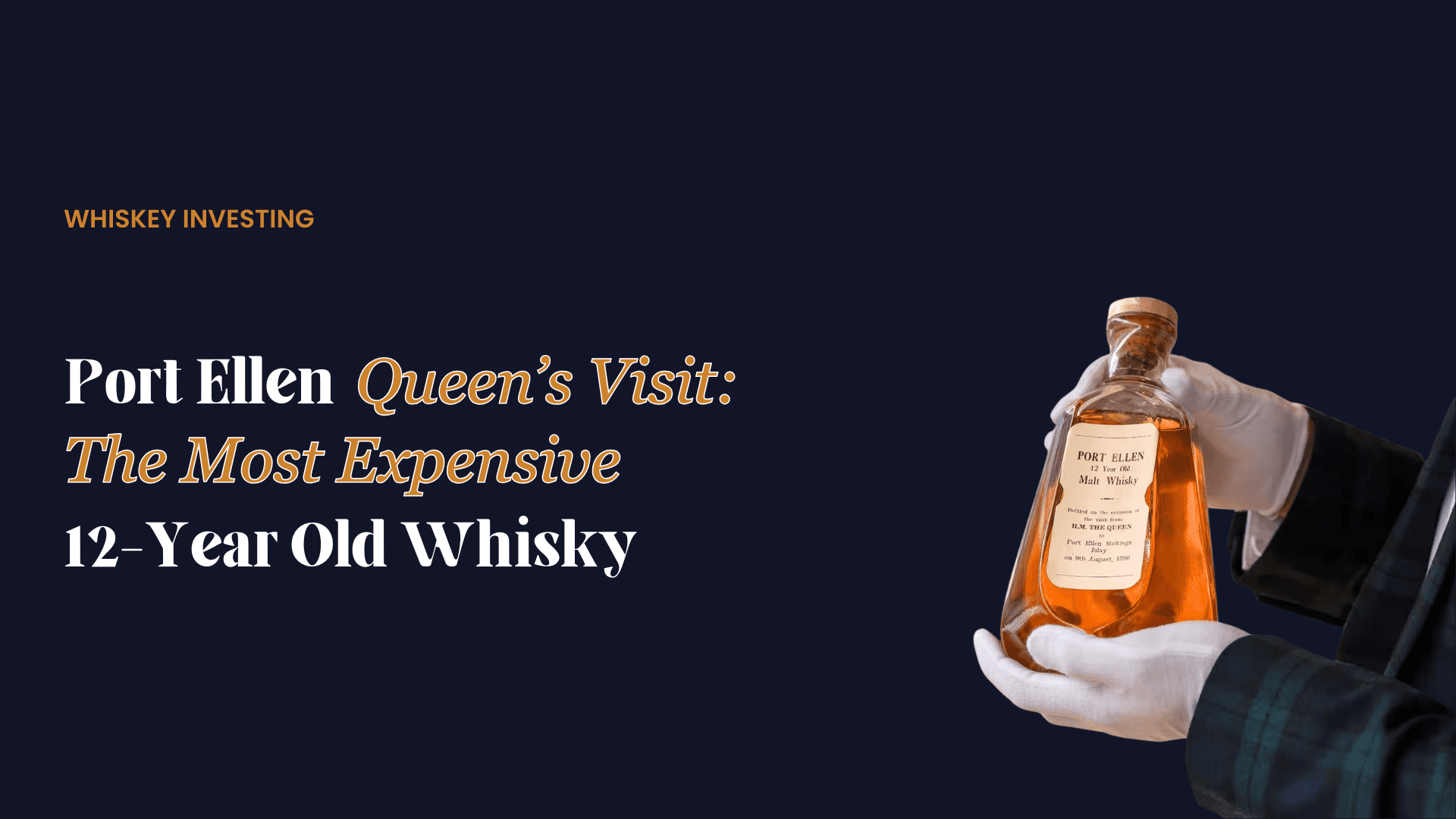
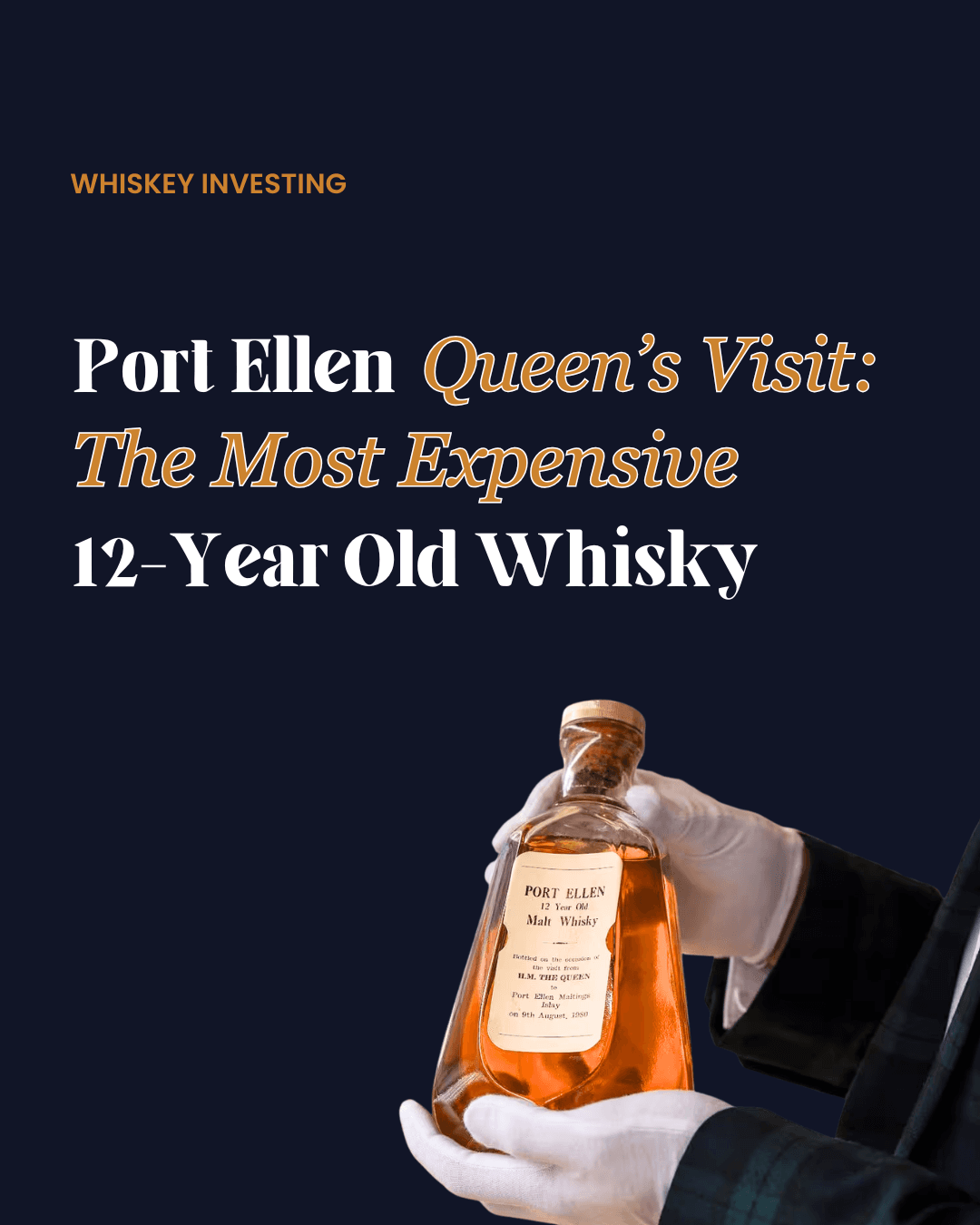
On June 6, 2022, Gordon McIntosh watched from his home in Glasgow as bidders from the UK, US, and Hong Kong battled over a bottle he'd found under the stairs years earlier. When the hammer fell at Whisky Auctioneer, the final price stunned even seasoned whisky collectors and alternative investment specialists: £100,000.
The bottle - a Port Ellen 12 Year Old bottled in 1980 to commemorate Queen Elizabeth II's visit to Islay - had just become the world's most expensive 12-year-old whisky. It was also the highest price ever paid for a Port Ellen at auction, eclipsing the previous record of £72,000 set just 16 months earlier.
For McIntosh, whose father had worked in the Scotch whisky industry and likely received the bottle as a gift, the sale represented a 3,025% return from the last time an identical bottle sold in 2011 for £3,200. For whisky investors and alternative asset collectors, it crystallized everything that makes Port Ellen the blue-chip ghost distillery: absolute scarcity, proven quality, royal provenance, and relentless price appreciation.
The Queen's Visit bottling isn't just rare whisky. It's the only whisky to score 99 out of 100 points on WhiskyFun - the highest rating legendary reviewer Serge Valentin has ever awarded. It's the only official distillery bottling Port Ellen ever released while the distillery was active. And with an estimated 40 bottles in existence, it's one of the rarest Scotch whiskies in the world.
This is the complete investment guide to how a forgotten bottle became a £100,000 collector's grail, why Port Ellen commands such devotion in the rare whisky market, and what the distillery's 2024 reopening means for investors seeking alternative assets with proven returns.
The Bottle: Royal Provenance Meets Investment Grade Whisky
On August 9, 1980, Queen Elizabeth II visited Port Ellen Maltings on the Isle of Islay. The maltings - built in 1973 to supply barley to Islay's distilleries - was a point of pride for the Scotch whisky industry. To commemorate the occasion, Port Ellen distillery decided to bottle a special expression that would become one of the most valuable whisky investments in history.
Legendary warehouseman Iain "Pinky" McArthur selected two bourbon hogsheads from 1967, the distillery's first year back in operation after a 37-year silence. The whisky was bottled at cask strength - the exact ABV remains unknown, though McArthur insisted it was bottled without reduction - and presented in a wooden box with a glass stopper.
The number of bottles produced was never officially confirmed, but it's accepted that enough were filled so the Queen and each senior staff member present could take one home. Industry estimates place the total at around 40 bottles.
Here's what makes the Queen's Visit extraordinary: It was the only official bottling Port Ellen released while the distillery was still producing. From its reopening in 1967 until its closure in 1983, Port Ellen whisky went exclusively into blends. The distillery never released a single malt for commercial sale during its operating years. The Queen's Visit was a one-time exception, created for a ceremonial occasion and distributed privately.
It's also the only known example of 1967 Port Ellen. The distillery restarted production on April 1, 1967, and this bottling represents the distillery's first whisky after nearly four decades of silence.
The bottles were essentially forgotten for decades. Port Ellen was a workhorse distillery that supplied spirit for blends like Johnnie Walker King George V and Big Peat. Nobody imagined that 40 years later, a single bottle would sell for six figures.
The Tasting: Utter Perfection
In 2015, during a special whisky tour called "The Islay Odyssey," one of the Queen's Visit bottles was opened and shared among a small group of whisky enthusiasts. Serge Valentin of WhiskyFun was among them.
His review awarded the whisky 99 out of 100 points - the highest score he has ever given to any whisky in more than two decades of reviewing thousands of expressions. His conclusion: "Utter perfection. After having tried quite a few whiskies, I think - well, I know - that I will never find a dram that's even better."
The tasting notes described a complex, elegant whisky that balanced Port Ellen's signature peat smoke with fruit, maritime salinity, and an extraordinary depth of character. Angus MacRaild, another respected whisky writer who tasted the Queen's Visit, noted its "stellar" quality and "utterly outstanding" complexity, length, and balance.
This wasn't marketing hype or auction house promotion. These were independent, highly experienced reviewers encountering a whisky that genuinely deserved its legendary status.
The 99-point score gave collectors empirical validation for what they'd long suspected: Port Ellen at its peak produced whisky of unmatched quality. And the Queen's Visit, drawn from the distillery's first year back in operation, captured that character in its purest form.
The Price Evolution: Whisky Investment Returns from £3,200 to £100,000
The Queen's Visit first appeared at auction in 2011. It sold for £3,200 - below its £3,500 estimate. At the time, Port Ellen was already collectible, but the market hadn't yet discovered the Queen's Visit.
Two years later, in 2013, another bottle sold for £6,300. The price had nearly doubled, but it was still far from today's stratospheric levels.
By 2016, the market had caught up. A bottle sold for £12,100 - nearly quadruple the 2011 price. The following year, 2017, saw another sale at £11,200. The Queen's Visit had established itself as a serious collector's item.
Then the market accelerated. In 2018, a bottle fetched £50,000 - more than quadruple the 2016 price. Three years later, in January 2021, Whisky Auctioneer sold a bottle for £72,000, setting what was then a distillery record.
The current record came 16 months later. On June 6, 2022, at the height of the Platinum Jubilee celebrations marking Queen Elizabeth II's 70 years on the throne, Gordon McIntosh's bottle sold for £100,000 (equivalent to approximately £117,000 or $125,000 including buyer's premium).
The timing was symbolic. The Queen's Visit had been bottled to commemorate her 1980 visit to Islay. Forty-two years later, during her Platinum Jubilee, the bottle achieved its record price.
Since then, the market has stabilized. In February 2025, a bottle sold at Whisky Auctioneer for £84,732 (approximately $105,000). While below the 2022 peak, this still represents a 2,548% return from the 2011 sale.
The price trajectory tells a clear story: From 2011 to 2022, the Queen's Visit delivered a 3,025% return over 11 years. That's an annualized return of approximately 37% - far outpacing traditional investments like stocks, bonds, or real estate.
The Distillery: Port Ellen's Rise and Fall - Creating Investment Grade Scotch
To understand why Port Ellen commands such reverence among whisky investors and collectors, you need to understand its history - and how close it came to being completely forgotten.
Port Ellen was founded in 1825 by Alexander Kerr Mackay on the south coast of Islay, Scotland's whisky island. Originally a malt mill supplying illicit distilleries on the Oa Peninsula, it was converted into a licensed distillery following the Excise Act of 1823, which reduced duties and encouraged legal whisky production.
Mackay went bankrupt within months. In 1833, the lease was taken over by 21-year-old John Ramsay, a Glasgow merchant and cousin to the mill's prior leaseholder. Ramsay would transform Port Ellen into one of Scotland's most innovative distilleries.
Under Ramsay's stewardship from 1833 until his death in 1892, Port Ellen became a center of whisky innovation. It was the first distillery to incorporate Septimus Fox's spirit safe design into the distillation process - now standard equipment in every Scotch distillery. Port Ellen pioneered whisky exports to the United States, shipping its first casks to America in 1848. Ramsay also partnered with Walter Frederick Campbell, the Laird of Islay, to establish a bi-weekly ferry service between the island and Glasgow, making Port Ellen the island's main ferry terminal and cementing whisky-making as Islay's dominant industry.
The Ramsay family operated Port Ellen until 1920, when it was sold to the Port Ellen Distillery Co., a partnership between blenders James Buchanan and John Dewar. Five years later, in 1925, the company merged with Distillers Company Limited (DCL), bringing Port Ellen into the orbit of the industry giant that would later become Diageo.
Then came the first long silence. In 1930, impacted by Prohibition and the Great Depression, DCL mothballed Port Ellen. The distillery remained closed for 37 years.
In 1966, responding to surging demand for peated whisky in blends, DCL began reviving Port Ellen. The distillery was modernized and reconstructed, with production capacity increased from two stills to four. On April 1, 1967, Port Ellen distilled its first spirit in nearly four decades.
For 16 years, Port Ellen operated as a workhorse distillery supplying peated malt for blends. Its whisky was highly regarded by blenders but never released as a single malt. The distillery was productive, efficient, and largely anonymous.
Then came the Whisky Loch - the industry-wide crisis of the early 1980s when oversupply crashed the market. Blenders needed less peated malt. Single malt whisky was still a niche category. DCL owned three distilleries on Islay: Port Ellen, Caol Ila, and Lagavulin. Something had to close.
Port Ellen drew the short straw. In May 1983, the distillery fell silent. The stills were dismantled and destroyed. Some buildings were demolished, others repurposed. In 1992, the license was officially canceled.
Port Ellen Maltings - the facility the Queen had visited in 1980 - continued operating. Thanks to a gentleman's agreement among Islay distillers (known as the Concordat), the maltings supplied barley to distilleries across the island. The maltings outlived the distillery and still operates today.
But the distillery was gone. For 40 years, no spirit flowed from Port Ellen's stills.
The Cult: How Port Ellen Became a Ghost Legend in Alternative Investments
Port Ellen's fame as a whisky investment came entirely posthumously. During its operating years, it was anonymous. After closure, it became one of the most revered distilleries in Scotland - and one of the strongest-performing alternative assets in the rare whisky market.
The transformation began in 2001 when Diageo launched its Special Releases series, featuring rare bottlings from closed or limited-production distilleries. The first release included a 22-year-old Port Ellen distilled in 1979. It sold out immediately.
For 17 consecutive years - from 2001 to 2017 - Diageo released one Port Ellen bottling annually as part of the Special Releases. The collection spanned ages from 22 to 37 years, all bottled at cask strength from casks filled during Port Ellen's final operating period (1967-1983).
These Annual Releases became highly sought-after collector's items. Early releases from the 2000s now sell for £1,000 to £3,000+ per bottle at auction. Later releases, particularly the final 37-year-old expressions from 2016 and 2017, command even higher prices.
The Annual Releases demonstrated two critical facts: Port Ellen whisky was exceptional in quality, and supply was finite and dwindling. Every bottle released brought Diageo closer to the day when Port Ellen's warehouses would be empty.
Independent bottlers also released Port Ellen single casks throughout the 2000s and 2010s. Gordon & MacPhail, Signatory Vintage, Douglas Laing, and Cadenhead's all bottled Port Ellen expressions from casks they'd purchased before the distillery closed. Some of these independent bottlings - particularly older vintages from the 1960s and 1970s - achieved legendary status among collectors.
The result was a cult following unlike any other distillery. Port Ellen developed a mystique as the ghost distillery - closed, demolished, irreplaceable, and producing whisky that collectors would pay almost any price to own.
According to the Port Ellen Index tracked by whisky investment platforms, the distillery's bottles appreciated 334% over the 10 years from 2012 to 2022 - one of the strongest performing distilleries in the collectible whisky market.
The Irony: She Visited the Maltings, Not the Distillery
Here's a detail that reveals just how overlooked Port Ellen was during its operating years: When Queen Elizabeth II visited Islay in 1980, she toured Port Ellen Maltings, not the distillery.
The maltings - a modern drum malting facility built in 1973 to supply barley to Islay's distilleries - was considered the more impressive industrial achievement. By 1980s standards, it was strange that the Queen would visit a maltings rather than a distillery. But that's precisely what happened.
Port Ellen distillery was a utilitarian industrial building housing four pot stills that churned out spirit for blends. Port Ellen Maltings was a cutting-edge facility supplying the entire island's distilleries. In 1980, the maltings mattered more than the distillery.
The irony is profound. Forty years later, Port Ellen Maltings still operates, still supplies Islay distilleries, and still performs its function efficiently and anonymously. Port Ellen distillery - demolished, closed, irreplaceable - commands six-figure prices for bottles that nobody wanted in 1980.
The Queen's Visit bottling exists because she visited the maltings, not because anyone thought the distillery was particularly special. It was a courtesy gift for a ceremonial occasion, not a calculated investment in future collectibility.
Nobody in 1980 imagined that bottle would one day sell for £100,000. If they had, Port Ellen would never have closed in 1983.
The Reopening: Port Ellen Reborn
On March 19, 2024, Port Ellen distilled spirit for the first time in 40 years.
The reopening was the culmination of a £185 million investment by Diageo - the final chapter in a program that also included reopening Brora distillery (another ghost distillery closed in 1983) and creating premium visitor experiences across its Scottish distilleries.
The new Port Ellen is not a simple reconstruction. Diageo designed the distillery from the ground up to be a laboratory for exploring smoke and peat in whisky while honoring Port Ellen's heritage.
At the heart of the new distillery are two pairs of copper stills. The first pair - named the Phoenix Stills - are precise replicas of Port Ellen's original stills, created using factory records from the 1980s and consultation with former Port Ellen employees. These stills will produce the classic smoky liquid that made Port Ellen legendary.
The second pair - the Experimental Stills - are linked to a Ten Part Spirit Safe, one of the most innovative pieces of distilling equipment ever created. While standard spirit safes allow three cuts during distillation (the heads, heart, and tails), Port Ellen's Ten Part Spirit Safe allows multiple cuts to be drawn from the heart of the run, accessing previously unexplored flavors and giving distillers unprecedented precision.
The distillery also features a dedicated on-site laboratory with a full-time technician to analyze and catalogue the experimental whiskies that emerge. Master Blender Aimée Morrison leads what Diageo calls the "Atlas of Smoke" - a research program exploring the nuances of peat smoke in whisky production.
Port Ellen is also carbon neutral from day one, with renewable biofuel powering the distillery and comprehensive water and heat recycling systems.
The reopening was marked by the release of Port Ellen Gemini in February 2024 - a paired set of two 44-year-old whiskies distilled in 1978 and bottled from three exceptional European oak casks. Only 274 sets were produced worldwide, priced at £45,000 per set (approximately $57,000).
In September 2025, Diageo announced the Port Ellen 200th Anniversary Edition - a 42-year-old single malt distilled in 1983 (the final year of production before closure) and aged in European oak. Limited to 150 bottles worldwide, it's priced at £7,500 per bottle.
These releases establish Port Ellen's positioning in the reopened era: ultra-premium, ultra-limited, ultra-luxury. Diageo is not trying to make Port Ellen accessible. They're maintaining its cult status while building toward the future.
The first whisky from the reopened distillery won't be released until at least 2036 - when the new spirit reaches 12 years of age. Some expect Diageo may release younger experimental expressions earlier, but nothing is confirmed.
Why the Queen's Visit Matters for Investors
For whisky investors, the Port Ellen Queen's Visit represents several compelling attributes:
Absolute Scarcity. With approximately 40 bottles produced and no possibility of more ever being made, the Queen's Visit has the scarcest supply of any significant Port Ellen bottling. Compare this to the Annual Releases, which ranged from 2,940 to 12,000 bottles per expression. The Queen's Visit will never be diluted by additional supply.
Proven Quality. The 99/100 WhiskyFun score isn't marketing - it's empirical validation from one of the whisky world's most respected independent reviewers. Quality matters in collectibles, and the Queen's Visit has the highest objective quality rating of any whisky ever reviewed.
Historical Significance. This is the only official Port Ellen bottling released while the distillery was active. Every other Port Ellen bottle on the market was released after closure. The Queen's Visit is unique in representing what Port Ellen chose to bottle when it had full control.
Royal Provenance. Commemorative bottlings tied to the British Royal Family have consistently outperformed in the collectibles market. The Queen's Visit combines royal history with whisky history in a way that resonates with collectors beyond the whisky community.
Track Record. From 2011 to 2022, the Queen's Visit delivered a 3,025% return - approximately 37% annualized. Even accounting for the 2025 sale at £84,732 (down from the £100,000 peak), the bottle has returned 2,548% since 2011, or about 26% annualized.
Market Depth. Unlike some ultra-rare whiskies that trade infrequently with unpredictable results, the Queen's Visit has a documented auction history spanning 14 years with multiple sales. This provides price discovery and liquidity (relative to other collectibles in this price range).
Distillery Reopening. The March 2024 reopening of Port Ellen raises the distillery's profile and introduces new collectors to the brand. Diageo's positioning of Port Ellen as an ultra-premium, experimental distillery supports long-term brand value. As new Port Ellen releases reach the market in the 2030s, interest in historic bottlings like the Queen's Visit should strengthen.
The Broader Port Ellen Market
While the Queen's Visit represents the pinnacle of Port Ellen collecting, the broader market for Port Ellen whisky remains strong across multiple price points.
The Diageo Annual Releases from 2001-2017 trade actively at auction. Analysis of 100 auction results from May 2024 to March 2025 shows the 1st Annual Release (1979, 22 years old) selling between £1,000 and £3,000 depending on timing and venue. Later releases - particularly the 14th and 17th expressions - command the highest prices.
UK auction houses consistently achieve premium prices compared to European venues, with price variations of 10-25% for identical bottles. US auctions remain limited but competitive, typically falling between UK and European pricing.
Independent bottlings of Port Ellen - particularly older vintages from the 1960s and 1970s - can achieve remarkable prices. The Port Ellen 1969 15 Year Old Celtic Label by Gordon & MacPhail, for example, recently sold for £8,988 at Whisky Auctioneer.
The market shows signs of stabilization after the significant correction from the 2020-2022 peak. This creates opportunities for investors willing to take a long-term view on a distillery with proven scarcity, quality, and collector demand.
The Investment Thesis
Port Ellen offers a compelling case study in whisky investment:
Finite Supply. Every Port Ellen bottle represents a piece of a finite whole. The distillery produced from 1967 to 1983 - just 16 years. The remaining stock declines with every bottle consumed or sold. Even with the distillery reopened, no new "old" Port Ellen will ever exist.
Blue-Chip Provenance. Port Ellen isn't a speculative micro-distillery. It's owned by Diageo, one of the world's largest drinks companies, with decades of brand-building behind it and massive investment ahead. Diageo has every incentive to protect and grow Port Ellen's brand value.
Proven Collector Demand. The Annual Releases sold out immediately year after year. Independent bottlings command premium prices. Auction activity is robust and sustained. Port Ellen isn't a fad - it's a decades-long collecting category.
Scarcity + Quality. Not every rare whisky is good, and not every good whisky is rare. Port Ellen combines both attributes. The liquid quality is proven by critic scores, blind tastings, and repeat purchase behavior. The scarcity is mathematical and absolute.
Diversification Within Scotch. For investors building whisky portfolios, Port Ellen provides Islay representation and ghost distillery exposure in a single category. It complements Macallan (Speyside), BTAC (American), and Japanese whisky.
The Queen's Visit sits at the apex of this thesis. It combines all of Port Ellen's investment attributes with additional layers of scarcity, provenance, and quality that justify its premium pricing.
Frequently Asked Questions About Port Ellen Whisky Investment
How many Port Ellen Queen's Visit bottles exist and why is it so rare?
The exact number was never officially confirmed, but industry consensus places the total at approximately 40 bottles. They were privately distributed to Queen Elizabeth II and the senior staff members who accompanied her during the August 9, 1980 visit to Port Ellen Maltings on Islay. No bottles were ever sold commercially at the time of production. This makes it one of the rarest whisky investments in existence - rarer than many Macallan releases or Japanese whisky collectibles.
Why is Port Ellen Queen's Visit worth £100,000 as a whisky investment?
Several factors drive the investment valuation: (1) Absolute scarcity of approximately 40 bottles with no possibility of more being produced; (2) The highest quality rating ever awarded by WhiskyFun (99/100 points); (3) The only official Port Ellen bottling released while the distillery was active; (4) The only known example of 1967 Port Ellen whisky; (5) Royal provenance commemorating Queen Elizabeth II's visit to Islay; (6) Proven track record of 3,025% appreciation from 2011 to 2022 - significantly outperforming traditional investments and most alternative assets.
Will Port Ellen make more Queen's Visit bottles after the distillery reopened?
No. The Queen's Visit was bottled from two specific bourbon hogsheads filled in 1967 to commemorate a specific historical event (the Queen's August 9, 1980 visit to Port Ellen Maltings). Those casks no longer exist and the historical moment cannot be recreated. Even with Port Ellen reopened in 2024 after £185 million investment by Diageo, no future bottlings can replicate the Queen's Visit's unique combination of provenance, age, and historical context. This makes existing bottles a finite investment opportunity.
How can I invest in Port Ellen whisky without spending £100,000?
Several more accessible whisky investment options exist: (1) Diageo Annual Releases from 2001-2017, which trade at £1,000-£3,000+ depending on the expression and auction venue; (2) Independent bottlings from Gordon & MacPhail, Signatory Vintage, and other bottlers, available at various price points for whisky investors; (3) Fractional ownership of rare Port Ellen bottles through platforms like Dram, which allow investors to access blue-chip ghost distillery whisky at lower entry points; (4) Newer releases from the reopened Port Ellen distillery, though these won't be available until the mid-2030s. For comparison, rare whisky investments have shown 68% appreciation over five years according to whisky investment tracking indices, making fractional ownership an attractive entry point for alternative asset investors.
How Dram Provides Access to Port Ellen and Ghost Distillery Whisky Investment
The Port Ellen Queen's Visit represents the pinnacle of whisky collecting - a £100,000 bottle with 40 copies in existence. For most investors seeking exposure to alternative assets and rare whisky, that's an impossibly high barrier to entry.
Dram changes the equation for whisky investment. By fractionalizing rare whisky into shares, Dram allows investors to own portions of blue-chip bottles like Port Ellen Annual Releases, historic independent bottlings, and other ghost distillery expressions - without needing six-figure capital.
You're not buying a proxy or a fund. You're buying fractional ownership of the actual physical bottle, stored in bonded warehouses, with transparent pricing tied to auction data and secondary market transactions.
Port Ellen demonstrates why whisky belongs in diversified alternative asset portfolios alongside fine wine, collectible cars, and rare art: finite supply, proven quality, decades-long track records, and returns that outpaced traditional investments. The Queen's Visit's 3,025% return from 2011 to 2022 isn't an anomaly - it's evidence of what happens when absolute scarcity meets genuine collector demand in the rare whisky market.
According to whisky investment tracking indices, rare whisky has shown approximately 68% appreciation over five years, with premium Scotch and ghost distillery bottlings consistently outperforming. The Port Ellen Index specifically demonstrated +334% over 10 years - one of the strongest-performing categories in the collectible whisky market.
For investors building alternative asset portfolios, Port Ellen offers Islay representation and ghost distillery exposure in a single category. It complements Macallan (Speyside single malt), Buffalo Trace Antique Collection (American whiskey), and Japanese whisky investments like Karuizawa.
The distillery may have been silent for 40 years. The investment case for rare whisky never stopped speaking.