The Collectibles Reset and the Structural Challenge of the Whiskey Market
Dec 20, 2025
A Market Reset, Not a Collapse
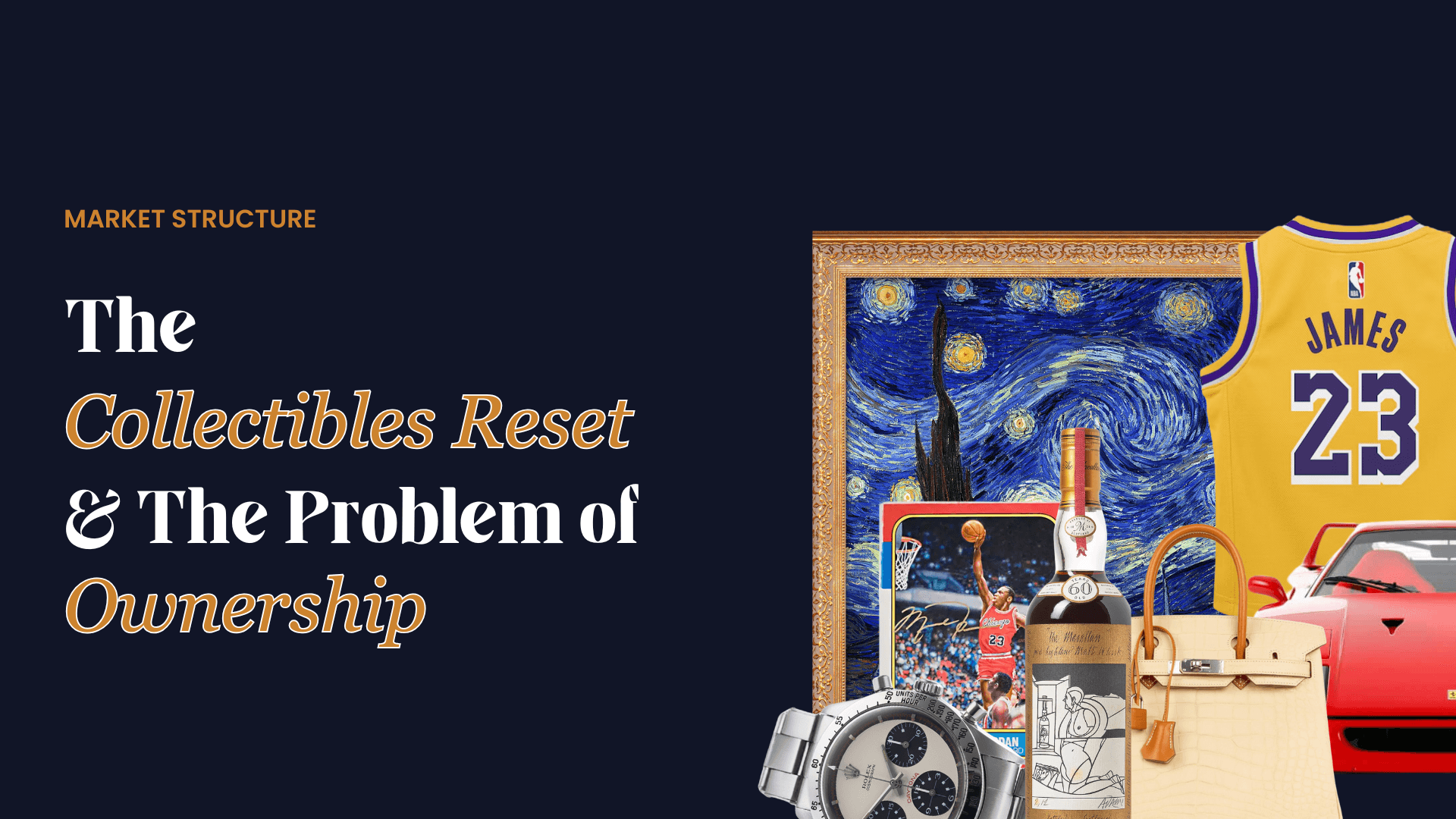
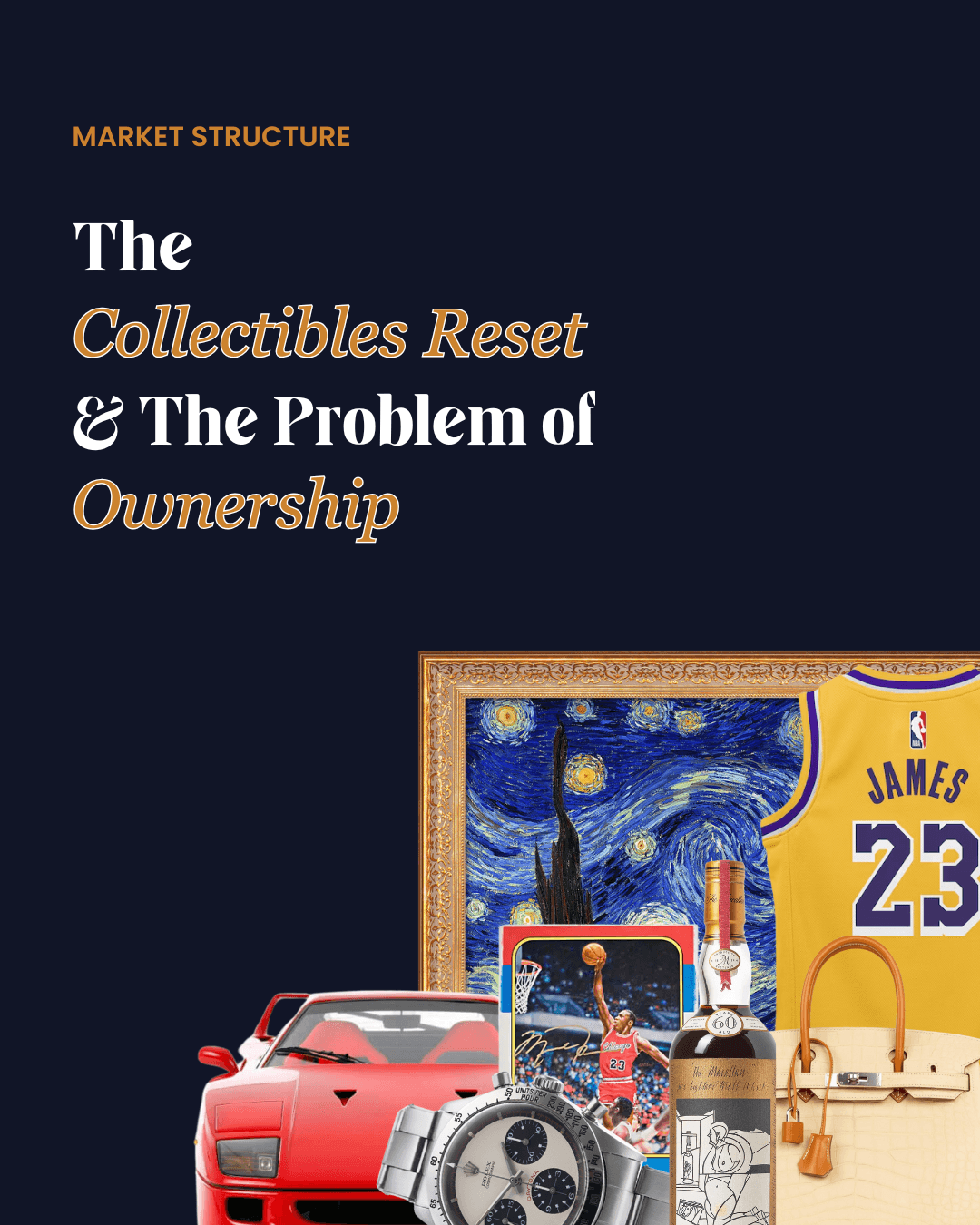
Over the past decade, collectibles evolved from passion assets into a recognized alternative investment category. Rare watches, fine art, classic automobiles, and collectible whiskey benefited from historically low interest rates, excess liquidity, and expanding global demand.
Global auction houses facilitate tens of billions of dollars in sales annually, with the overall auction market valued at an estimated $68 billion in 2024 and combined sales at Christie’s and Sotheby’s alone exceeding $13 billion in 2025.
Beginning in 2021 and accelerating through 2023, rising inflation, higher interest rates, and tighter financial conditions triggered a broad correction across luxury assets. Transaction volumes slowed, speculative demand retreated, and prices normalized.
This was not a collapse. It was a macro-driven reset, where higher rates and tighter liquidity stripped away speculation and exposed how decisive ownership structure, liquidity, and regulation truly are.
Collectibles Under Pressure: The Macro Forces Behind the Correction
Interest Rates and the Cost of Illiquidity
From 2020 to 2023, U.S. benchmark interest rates rose from near zero to above 5 percent. This fundamentally altered the attractiveness of illiquid, non-yielding assets.
Collectibles do not generate cash flow. As yields reappeared in public markets, capital rotated toward liquid, income-producing instruments. Major auction houses reported double-digit declines in transaction volumes across several collectible categories between 2022 and 2023, driven primarily by reduced speculative participation.
Inflation, Liquidity Tightening, and Deleveraging
Persistent inflation reshaped allocation decisions, while tighter lending standards reduced leverage that had quietly supported high-end collectibles. Margin financing and asset-backed credit facilities became harder to access, compressing bids and accelerating price discovery.
What emerged was a more disciplined market focused on fundamentals rather than momentum.
Why Whiskey Faces the Highest Frictions Among Collectibles
Whiskey shares the same core value drivers as other top collectibles, including scarcity, provenance, and global demand. However, it faces constraints that most other categories do not.
Unlike art, watches, or cars, whisky is a regulated consumable. That distinction fundamentally alters how ownership, transfer, and liquidity work.
Alcohol as a Highly Regulated Asset
Alcohol is governed by a layered legal framework shaped by taxation, public policy, and post-Prohibition controls. These laws were never designed with collectible ownership in mind, yet they directly affect how whisky can be owned and traded.
Key sources of friction include federal and state licensing requirements, excise taxes triggered by resale or movement, import and export restrictions, and jurisdiction-specific resale limitations.
As values rise, regulatory exposure increases. A private transfer that would be trivial for a painting or watch can become legally complex or prohibited when alcohol is involved.
The U.S. Three-Tier Distribution System
In the United States, whiskey is further constrained by the three-tier distribution system involving producers, wholesalers, and retailers.
This framework restricts transactions between non-adjacent tiers and limits private resale outside licensed channels. For collectors, this results in legally constrained peer-to-peer transfers, fragmented secondary markets, and costly cross-border transactions.
Fractional Ownership: The Legal Path to Access in the U.S.
Fractional ownership addresses one of the most persistent constraints in collectibles: access.
As asset values rise, direct ownership becomes limited to a shrinking pool of buyers. In the United States, there are only two securities exemptions explicitly designed to allow retail investors to participate in private offerings of this kind: Regulation Crowdfunding and Regulation A+.
Regulation Crowdfunding (Reg CF)
Reg CF allows companies to raise up to $5 million per year from both accredited and non-accredited investors, subject to individual investment limits and standardized disclosures.
It is purpose-built to enable broad retail participation, lower minimum investment thresholds, and provide mandated transparency and investor protections.
Regulation A+ (Reg A+)
Reg A+ expands access further through two tiers. Tier 1 allows raises up to $20 million in a 12-month period. Tier 2 allows raises up to $75 million, with enhanced reporting requirements.
These exemptions are not loopholes. They are specifically designed to make regulated access possible.
Tokenization: What It Means and What It Does Not
Once ownership is structured legally, the next question becomes how that ownership is recorded and transferred.
Tokenization is often discussed as a technological shortcut to liquidity. In reality, it is simply a method of recording ownership, not a substitute for legal structure.
In the United States, a token that represents fractional ownership is still a security.
Security Tokens Are Still Securities
If a token represents equity in a collectible, it remains subject to U.S. securities laws, including registration or exemption requirements, disclosure obligations, and transfer restrictions.
Putting ownership on a blockchain does not remove regulation. It changes the format of the ownership record, not the legal obligations attached to it.
Why Securitization Comes First
Because of this, collectibles must be securitized first under valid exemptions such as Reg CF or Reg A+ before ownership interests can be represented digitally.
Only once ownership is legally issued and fully compliant can tokenization enhance transparency, auditability, and transfer efficiency.
Why Dram’s Approach Is Built for This Moment
The recent correction in collectibles reinforced a fundamental truth. Value endures, but only when supported by structure.
Whisky’s regulatory complexity makes it one of the hardest collectibles to scale responsibly. That difficulty is precisely what makes it such a powerful test case.
At Dram, we treat collectibles as an infrastructure problem, not a trading problem. Our approach combines retail accessible fractional ownership, legally enforceable equity interests, professional custody, and digital ownership records that reflect real securities.
We believe the future of collectibles will be defined by confidence, regulation, and enforceable clarity of ownership.